











Is There a Best Day to Buy Pokémon Cards on eBay?
We analysed 64,910 recorded sales to see whether the day of the week affects prices, or simply how many cards are sold. Explore the findings in three charts.
TCGBerg Research Desk
Published Updated 4 MIN read
Does the day of the week affect what you pay for a Pokémon card, or simply how many cards are sold?
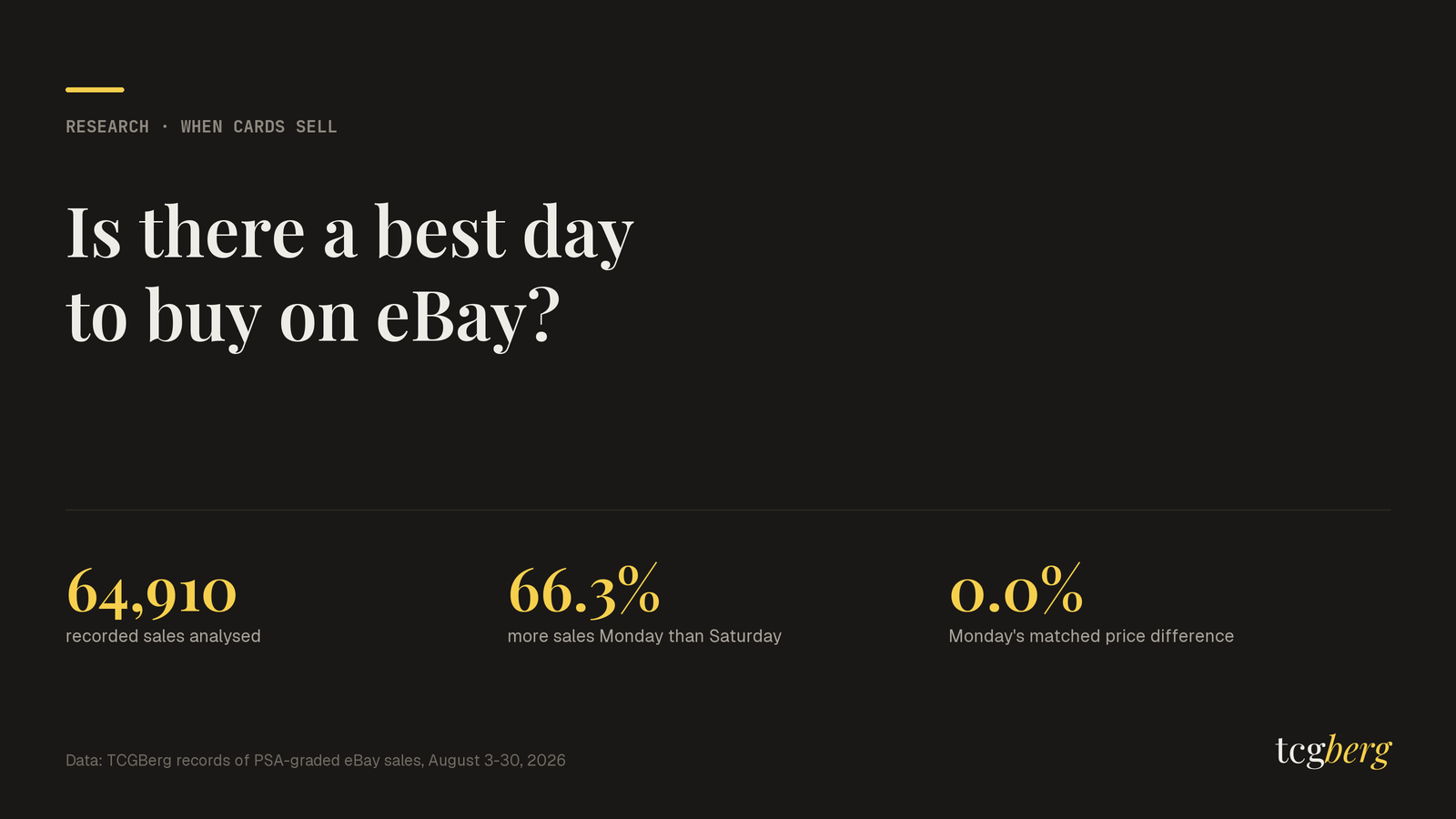
To find out, we analysed 64,910 eBay sales of English, PSA-graded Pokémon cards recorded over four complete weeks in August 2026. We first looked at when sales occurred, then compared prices for the same printings in the same PSA grades across each weekday.
The result: this sample shows a clear weekly sales rhythm, but it does not establish a consistently better day to buy.
Monday was the busiest day, with 12,338 recorded sales, compared with 7,421 on Saturday, a 66.3% difference. Yet after matching comparable cards, the typical weekday difference from each pair's own baseline stayed below 1.0%.
More sales on a particular day do not necessarily mean buyers are paying more for the same cards.
Pokémon sales follow a weekly rhythm
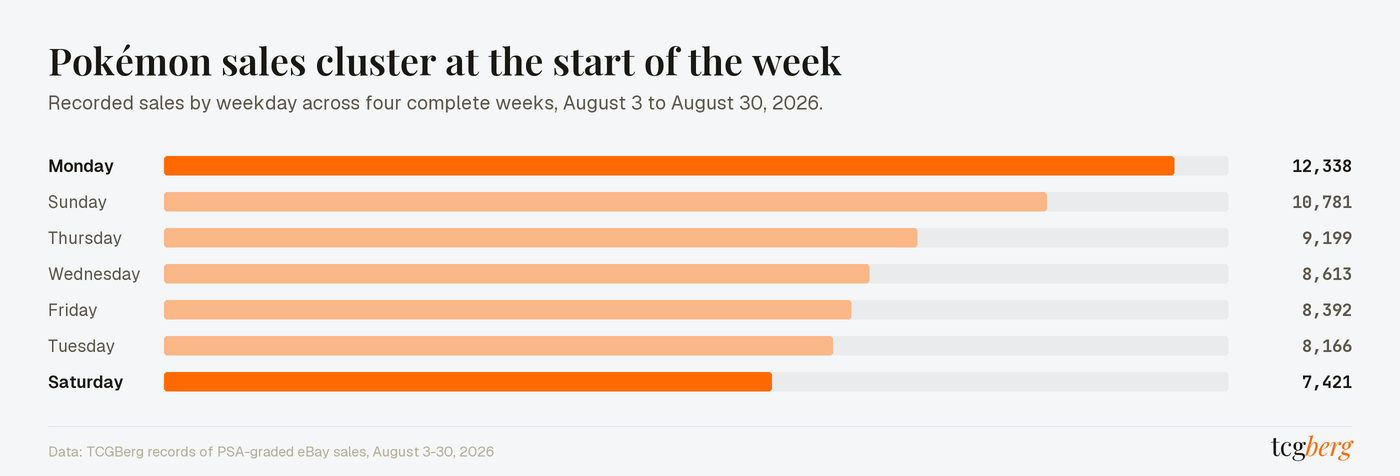
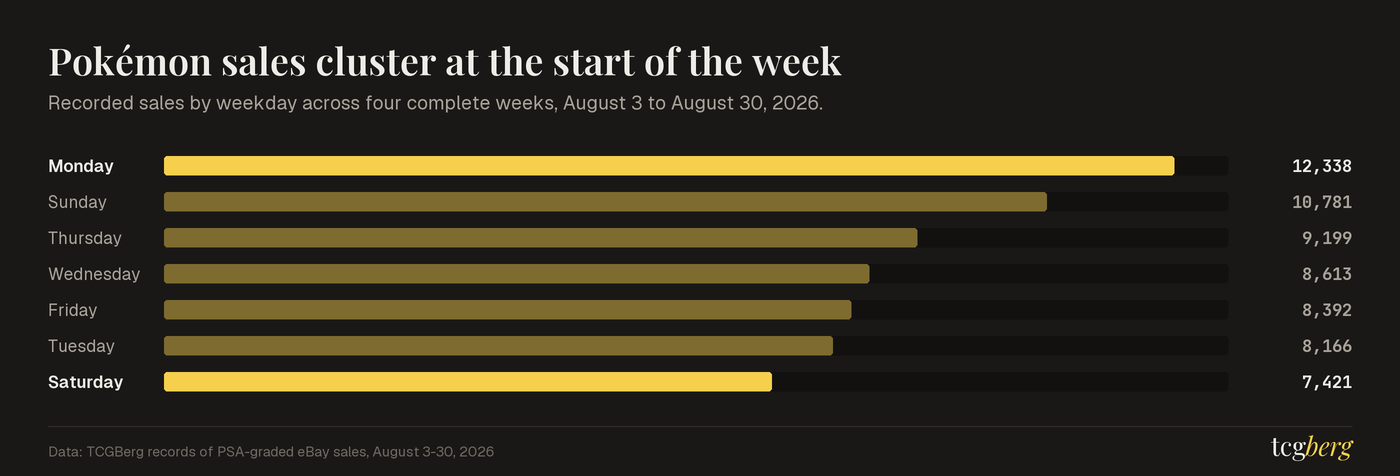
Our sample covers 64,910 recorded sales from August 3 to August 30, 2026. The period contains exactly four of every weekday, so no day benefits from appearing more often.
Monday recorded the most sales in three of the four weeks. Sunday led in the other and ranked second overall, while Saturday had the lowest total. Mondays accounted for 19.0% of all recorded sales.
This is a clear pattern in our data, but not a measure of the entire Pokémon market. The analysis covers English, PSA-graded cards sold on eBay, and the dates reflect the source’s recorded sale date. We cannot determine each buyer’s local time or reliably separate auctions from fixed-price purchases.
Matching the cards before comparing prices
Comparing average prices by weekday would be misleading. If Monday included more expensive chase cards than Saturday, its average price would naturally be higher, even if buyers paid no weekday premium.
We therefore limited the analysis to exact printing-and-grade combinations with at least three recorded sales on every weekday.
This produced 196 printing-and-grade pairs, covering 154 printings, 32 sets and 14,334 sales. The same pairs appear in every weekday comparison, with equal weight given to each pair.
For each pair, we compared its median price on a given weekday with its median across the full four-week period. Medians reduce the influence of unusually high or low individual sales.
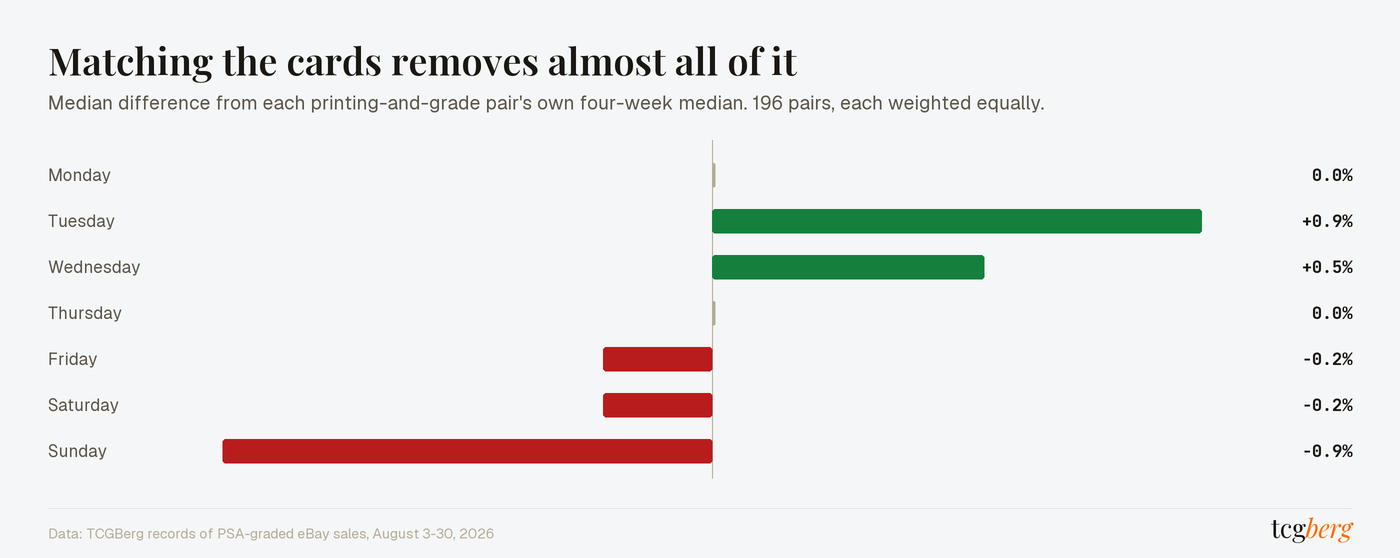
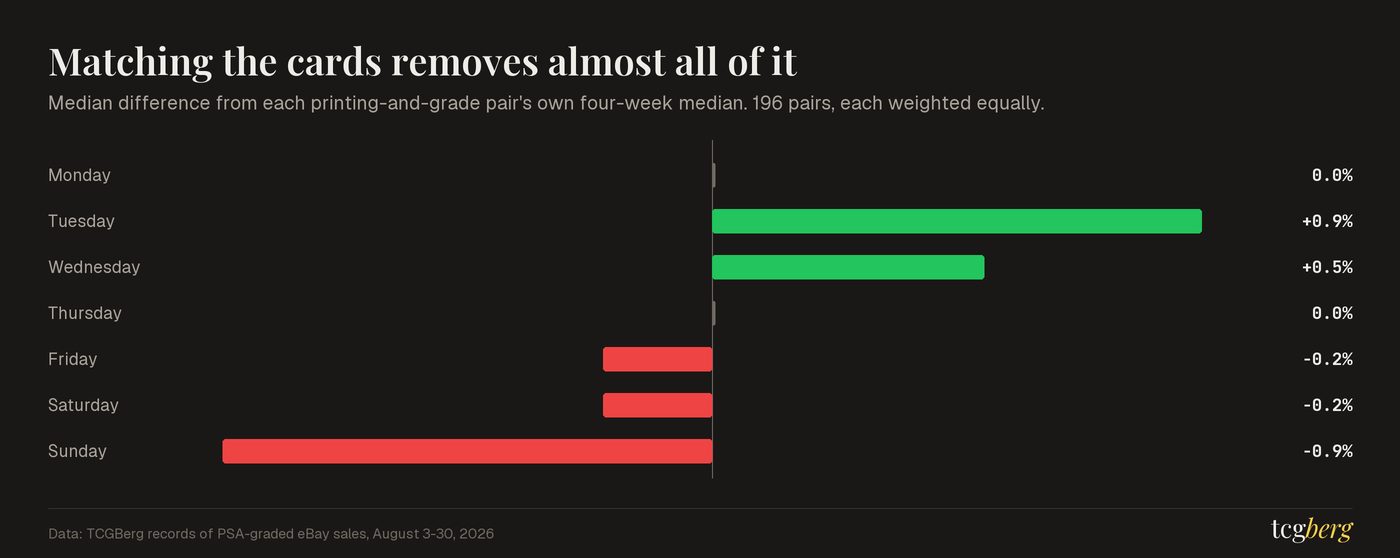
Across the pairs, the median matched price difference ranged from -0.9% on Sunday to +0.9% on Tuesday. Monday's median was 0.0%, despite having far more recorded sales.
| Recorded weekday | Sales in the full sample | Matched price difference |
|---|---|---|
| Monday | 12,338 | 0.0% |
| Tuesday | 8,166 | +0.9% |
| Wednesday | 8,613 | +0.5% |
| Thursday | 9,199 | 0.0% |
| Friday | 8,392 | -0.2% |
| Saturday | 7,421 | -0.2% |
| Sunday | 10,781 | -0.9% |
Individual cards did not all behave alike. Some were cheaper on a given day, while others were more expensive. A near-zero overall result does not mean every card sold for the same price throughout the week.
We also checked whether price movements during August were influencing the result by comparing each sale with its printing-and-grade median for that week. The daily differences narrowed to between -0.5% and +0.5%, supporting a modest reading of the observed weekday price gaps.
Was there a weekend discount?
We also compared each pair’s weekend median with its weekday median.
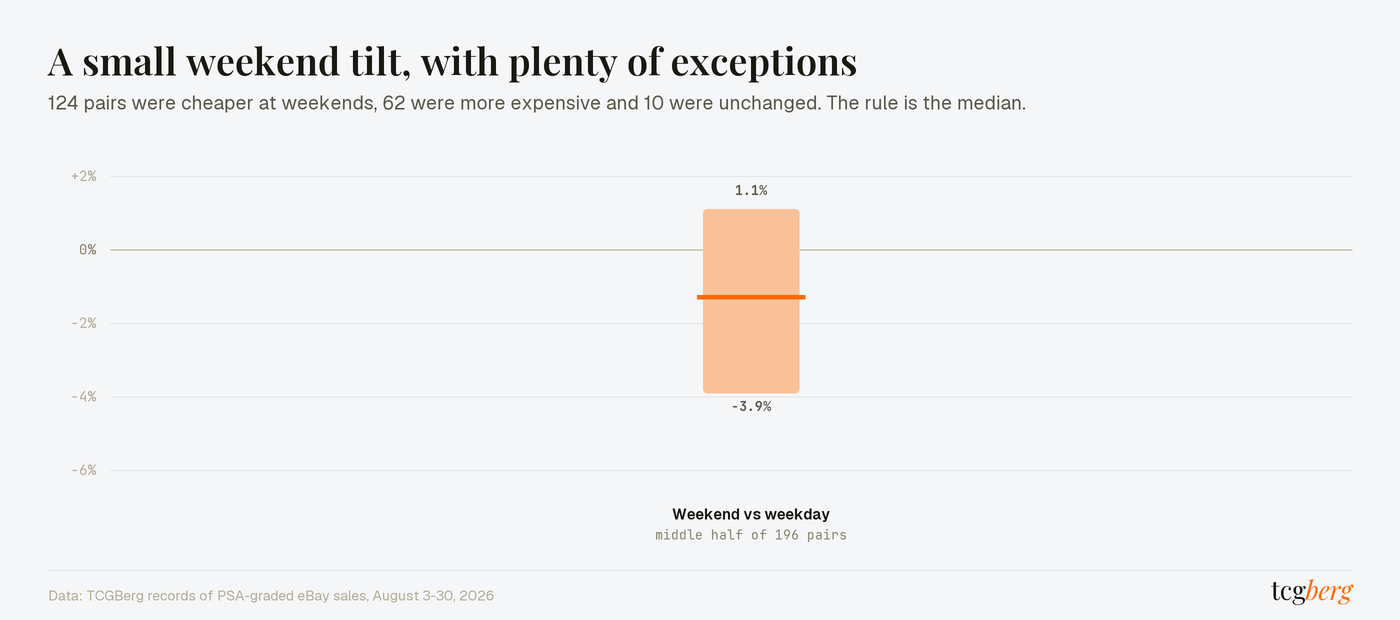
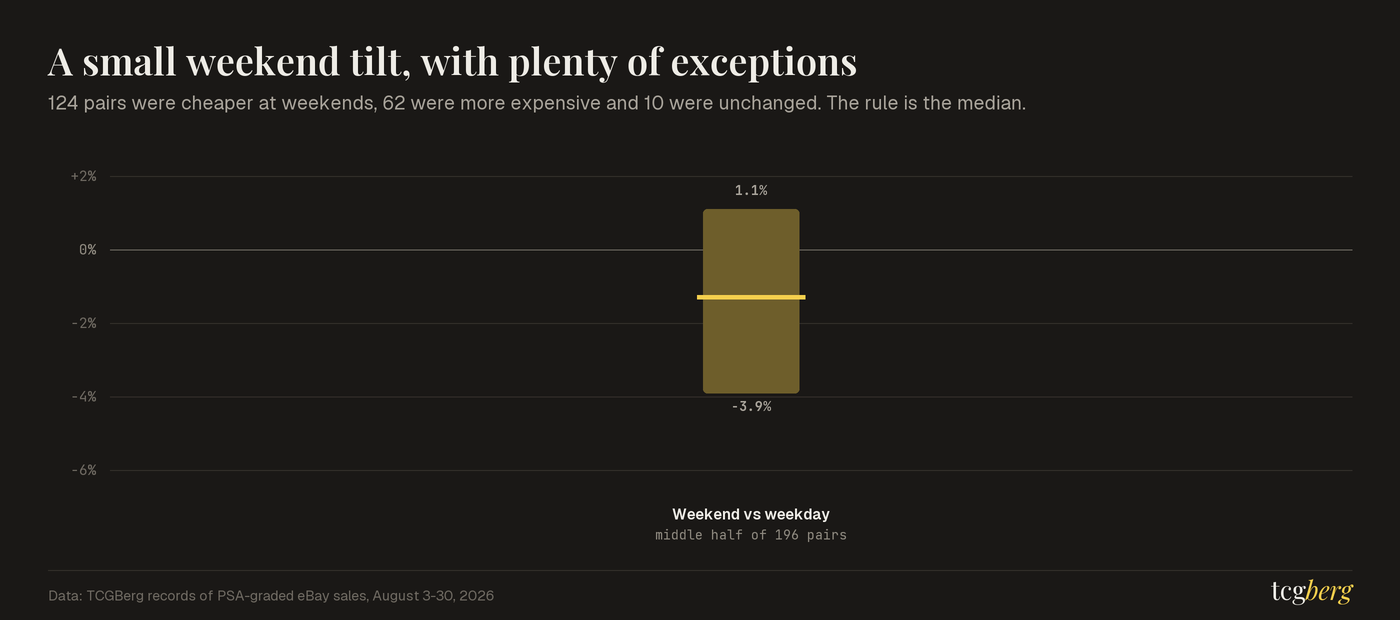
The median weekend difference was -1.3%. Of the 196 pairs, 124 were cheaper on weekends, 62 were more expensive and 10 were unchanged. The middle half of the differences ranged from -3.9% to +1.1%.
That suggests a small weekend tilt, but with plenty of exceptions. It is not strong enough to make Sunday a general buying rule or Monday a selling strategy.
The study covers one four-week period and includes only cards that sold frequently enough to compare. Differences in card condition, listing quality, seller reputation and sale format may also affect individual results.
What collectors can take from this
The practical takeaway: compare the card before choosing the day.
Some days brought considerably more sales activity in our sample. The small matched price gaps are a reason to check the exact printing, grade, condition and listing terms before treating a calendar pattern as a buying signal.
Start by matching the exact printing and PSA grade, then review several recent sales before assessing a current listing.
Use our card search or Pokémon price guide to identify the correct printing. A watchlist can also help you follow the same cards over time instead of chasing whichever cards happen to be busiest that day.
Method and sources
The analysis uses TCGBerg data for PSA-graded Pokémon card sales on eBay. We included positive recorded prices for PSA grades one through ten across English Pokémon sets in the public catalogue.
Article figures are fixed to the stated study date. Linked card pages and the market panels show newer data when available. TCGBerg fair values are modelled estimates with a sales-evidence rating, not quotes. Nothing here is financial advice. How fair value is computed. More from Research.